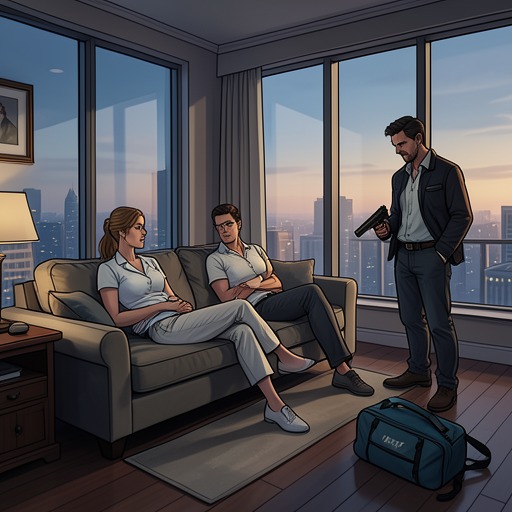
Morales assassination of Lucy and hostage-taking incident
Kay ScarpettaThe Morales hostage attack is the decisive confrontation between Mike Morales and the investigators pursuing him. Morales enters Jaime Berger’s penthouse armed and equipped for restraint, shoots Lucy Farinelli, and takes Kay Scarpetta and Jaime Berger hostage. The attack makes the previously reconstructed murders brutally present: the same kind of bindings, clinical materials, staged behavior, and possessive violence that marked the victims’ deaths are now directed at the people who identified the pattern. The assault ends when Lucy, badly wounded but still able to act, shoots Morales, while Pete Marino cuts the women free and summons emergency help.
Causes and Criminal Pattern
The attack follows the investigation’s recognition that the deaths of Bethany and Rodrick were connected to Terri Bridges’s murder. Bethany, a twenty-one-year-old woman who had moved from North Carolina to Baltimore, had become involved in dangerous efforts to obtain anabolic steroids; she was found naked, with her wrists and ankles bound, strangled with an object that was never recovered, and discarded in a harbor container. Rodrick, a fourteen-year-old boy from a prominent family in Greenwich, Connecticut, was also addicted to anabolic steroids. He was found naked, bound at the wrists and ankles, and strangled, his body dumped near the Bugatti dealership. Neither case had produced usable DNA or a suspect.
The pattern becomes more specific when Georgia Bacardi compares photographs of the anklets. Terri’s anklet matches those associated with the two earlier victims: each is a very thin, ten-karat gold chain with a herringbone pattern, approximately twenty-five centimeters long, the sort of inexpensive item available from a shopping-center kiosk or online. The contrast between the cases is important. Bethany and Rodrick were probably approached while seeking drugs in exchange for sex and were abducted by someone driving around and waiting for an opportunity; Terri was found indoors, making it uncertain whether she had been selected as a target or whether her boyfriend had staged the scene.
The anklet is interpreted as a sign of domination rather than affection. Kay Scarpetta considers the possibility that the murderer both carries away and leaves behind souvenirs, perhaps placing the anklet on Terri after her death. Benton Wesley distinguishes this emblem from rings used in another series of killings: a ring suggests possession in the language of making someone one’s own, whereas an anklet resembling a shackle signifies power and ownership. The same symbol later appears on Eva Peebles, whose body is displayed with a thin gold anklet around her left ankle, just as Terri had worn one. The recurrence turns an apparently minor piece of jewelry into a behavioral signature.
The later revelation identifies Morales as the murderer. Jaime Berger understands that the videos establish the pattern without showing his face. Morales had killed Bethany in his bare apartment in Baltimore in the summer of 2003, after graduating from Johns Hopkins medical school, and killed Rodrick several months later, abandoning the boy near the Bugatti dealer in Greenwich. Morales probably encountered Bethany through veterinary work in Baltimore and Rodrick through a part-time veterinary job in Greenwich. In both murders, as in Terri’s, he bound the victim’s wrists, wore latex gloves, and used the same lubricant. His theft of an opened container of Aqualine from his workplace may have been part of the method from the beginning, possibly helping confuse investigators by mixing DNA profiles.
The Hostage Seizure
Morales arrives at Berger’s penthouse with a small sports bag. His pupils are enlarged, and the bag contains a folded tripod, colorless nylon straps, and other implements. The straps immediately terrify Scarpetta because she recognizes their intended use. Her first instinct is to offer herself in exchange for Berger, but Morales dismisses her plea. His indifference makes the encounter less a negotiation than an execution of a prepared procedure.
He moves first against Berger, grabbing her wrists behind her back, binding them together, and pulling her toward the sofa before forcing her to sit. He then binds Scarpetta’s wrists extremely tightly. The restraint produces immediate physical consequences: cramps seize her fingers, and the pressure feels like a metal clamp cutting off the veins and pressing into the bones. The attack therefore reproduces the bodily logic of the earlier cases while placing Scarpetta in the position of the victim. The forensic pattern is no longer an image or hypothesis; it is pain experienced directly through the body.
Morales also carries the equipment of surveillance and fabrication into the room. A handheld computer displays a GPS route as a thick pink line moving across a map. From the bag he removes a small pair of Brooks running shoes and a plastic bag containing the polyvinyl impressions taken from Oscar Bane’s fingertips. The bag is greasy, as though the impressions have been coated with oil or ointment. Morales’s possession of these materials links the hostage scene to the wider manipulation of Oscar’s identity and movements, showing that the attack is part of a larger plan rather than an isolated burst of violence.
Lucy’s Shooting and the Final Reversal
Before Marino enters, Morales reaches Lucy through the upper part of the penthouse. Lucy stands in a steam-filled cabin, trying to work out how to speak openly with her aunt about the situation. When she pushes the door open, the retreating steam reveals Morales waiting directly in front of her. He smiles while aiming a pistol at her head and then shoots her. Scarpetta later hears Morales describe the wound with grotesque satisfaction, saying that Lucy has a bullet in her head and boasting about the intelligence he has supposedly destroyed that morning.
Lucy’s condition is severe but not immediately fatal. Blood covers the threshold, the bathroom floor, the hardwood gallery, and the area around her body. She has crawled from the bathroom toward the place where she shot Morales, and Scarpetta initially cannot determine where Lucy has been hit because her hair, neck, and bare back are saturated with blood. Lucy is found leaning against a wall with a towel across her lap, while the .40 Glock lies beside her. The image reverses Morales’s intended hierarchy: he has treated Lucy as a helpless target, yet her wounded body has carried her to the position from which she can end the attack.
Marino’s entrance creates the final tactical turn. He opens the penthouse door with one finger, draws his Glock from his leather jacket, and advances through the curved opening toward the sunken living room. He sees Berger and Scarpetta bound on the sofa and recognizes that the situation is already critical. Morales emerges from behind the round sofa with a gun pressed to Scarpetta’s head and orders Marino to drop his weapon. When Morales raises his pistol away from Scarpetta and aims at Marino, a laser point settles near Marino’s temple; Morales taunts him and demands that he say “mammie.”
The gunshot comes from the gallery. Morales falls, his body collapsing with the abruptness of a marionette whose strings have been cut. Blood spreads from the side of his head across the black marble floor. Marino takes Morales’s gun, calls emergency services, and uses poultry shears from the kitchen to cut through the restraints around Scarpetta’s and Berger’s wrists. The weapon choice is practical and improvised, contrasting with Morales’s carefully assembled bag of instruments and turning an ordinary kitchen tool into the means of release.
Consequences and Aftermath
The attack confirms Morales’s identity through action even though his face had remained hidden from the recorded murders. Berger had recognized the logic of the videos, but the penthouse assault supplies the missing continuity: the murderer who bound the earlier victims, used latex gloves and Aqualine, manipulated evidence, and left the golden anklet now brings the same methods against the investigators. His equipment, his language, and his treatment of the hostages expose the criminal pattern more forcefully than a confession would have done.
The apparent victory carries severe human cost. Scarpetta is freed but immediately runs upstairs, unable even to feel her hand on the banister. She finds Lucy drenched in blood and cannot tell at first where the bullet has struck. Lucy has stopped Morales, yet she has done so while gravely injured. The scene’s value shift is consequently double-edged: freedom and survival are restored for the hostages, but safety has been purchased through Lucy’s shooting and Morales’s death.
Scarpetta’s response is shaped by overwhelming self-blame. When Morales first puts the gun against the back of her head, she is less frightened than bewildered by the collapse of any intelligible connection between her actions and their consequences. She believes it is her fault that Morales entered Berger’s penthouse and that her weakness and naïveté have exposed others to tragedy. Her guilt expands beyond the immediate crisis to her family’s poverty, her father’s death, her mother’s unhappiness, Dorothy’s borderline personality disorder, and the suffering Lucy has endured. The hostage attack thus becomes not only an external assault but also a psychological reckoning with the burden Scarpetta assigns herself.
Narrative Significance
The event gathers the book’s forensic clues into a single embodied confrontation. The gold anklet first functions as a repeated object at distant crime scenes, then as a symbol of power, and finally as part of a threat aimed at the investigators themselves. The nylon straps echo the victims’ bindings; the latex gloves and Aqualine connect the penthouse to Morales’s professional and criminal routines; the GPS display and Oscar’s altered fingertip impressions connect the violence to surveillance and deception. Each object crosses from evidence into immediate danger.
The attack also reverses the direction of looking. Earlier, Scarpetta and her colleagues study bodies, photographs, videos, and traces in order to reconstruct what happened. In the penthouse, Morales turns the investigators into watched and controlled bodies, while the evidence surrounding him becomes physically present in his bag. Yet the reversal does not hold. Marino’s entry, Lucy’s resistance, and the final gunshot restore the investigators’ capacity to interpret and act. Morales tries to reduce people to objects under his control; the survivors answer by recovering agency, even at the cost of injury and lasting trauma.